Home

Lossless Context Management for long-horizon LLM agents







LLMs suffer from context rot: accuracy degrades 30–40% before hitting nominal token limits — not because the model runs out of space, but because reasoning quality collapses as the window fills with stale content.
The standard fix — telling the model to "summarize itself" — is unreliable. The model may silently drop constraints, forget file paths, or produce a summary that is itself too large.
mnesis solves this by making the engine — not the model — responsible for memory. It is a Python implementation of the LCM: Lossless Context Management architecture.
Benchmarks
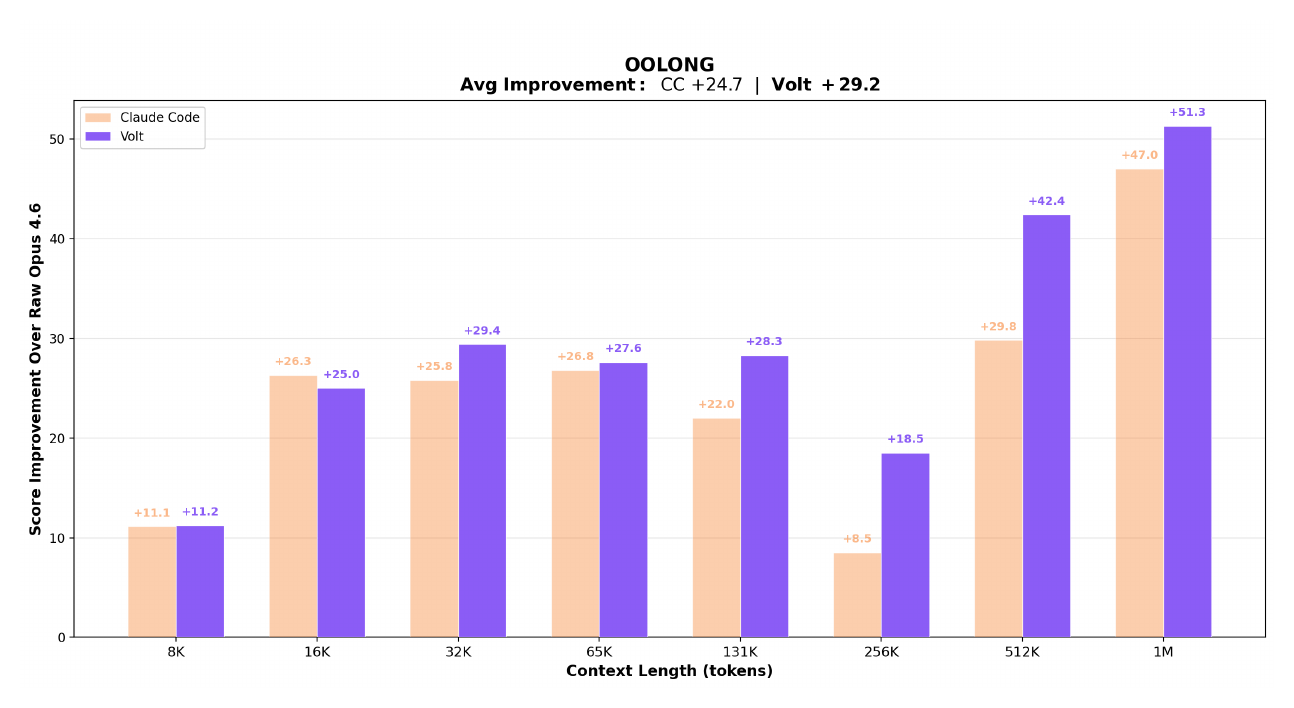
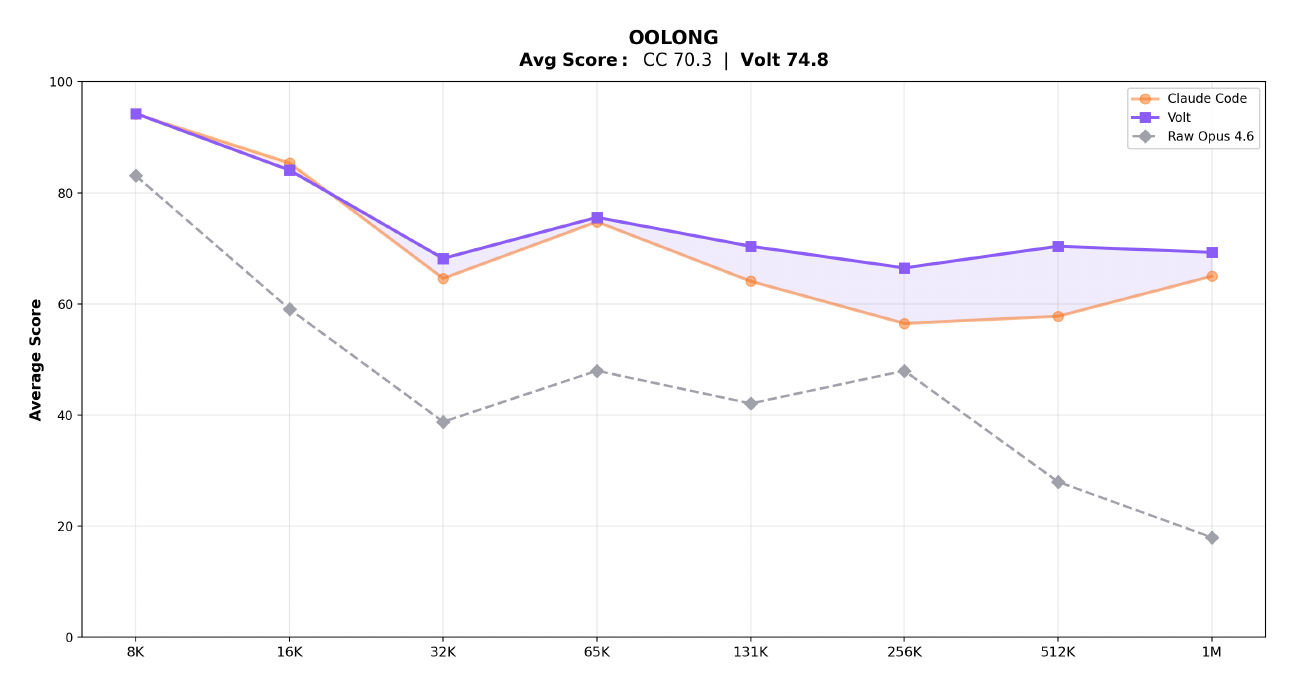
Evaluated on OOLONG, a long-context reasoning and aggregation benchmark. Both LCM-managed and Claude Code agents are built on Claude Opus 4.6; the gap comes entirely from context architecture.
Chart summary
The charts below compare LCM-managed context against Claude Code and unmanaged Opus 4.6 across context lengths from 8K to 1M tokens. Raw Opus 4.6 uses no context management — scores collapse past 32K tokens.
Score improvement over raw Opus 4.6 at each context length:
Absolute scores vs raw Opus 4.6 baseline:
How it works
Traditional agentic frameworks ("RLM" — Recursive Language Models) ask the model to manage its own context via tool calls. LCM moves that responsibility to a deterministic engine layer:
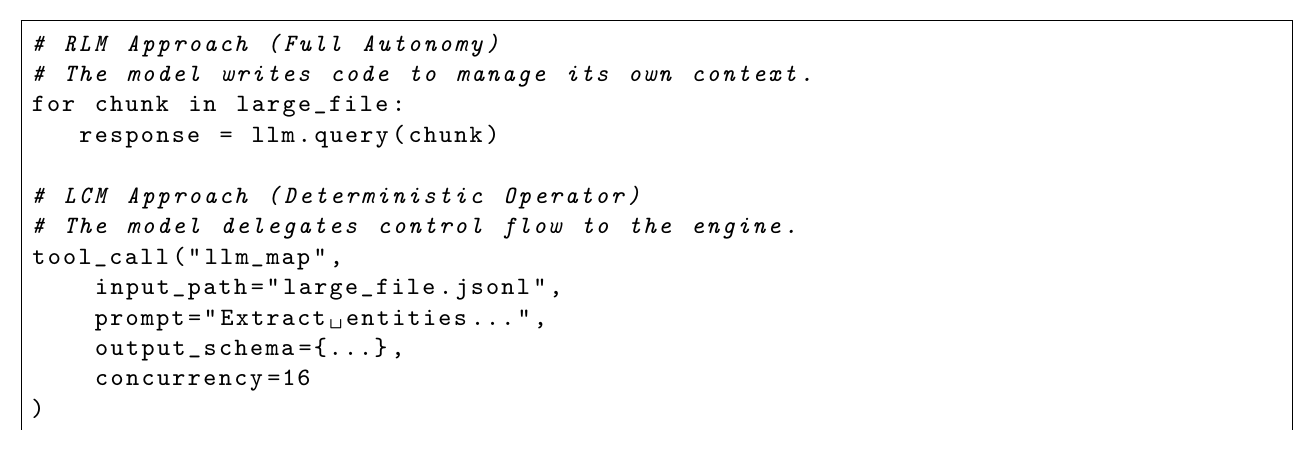
The engine handles memory deterministically so the model can focus entirely on the task.
Key properties
- Context trigger
RLM uses model judgment. mnesis uses a configurable token threshold — deterministic, not probabilistic.
- Summarization failure
RLM risks silent data loss. mnesis has a three-level fallback that never fails — Level 3 is always deterministic.
- Tool output growth
RLM lets tool outputs grow unbounded. mnesis uses a backward-scan pruner to tombstone stale outputs.
- Large files
RLM inlines files, eating the token budget. mnesis uses content-addressed file references with structural summaries.
- Parallel workloads
RLM is sequential or ad-hoc. mnesis provides LLMMap and AgenticMap operators for true parallelism.
- History
RLM history is ephemeral. mnesis keeps an append-only SQLite log — nothing is ever deleted.
Quick install
import asyncio
from mnesis import MnesisSession

async def main():
    async with MnesisSession.open(
        model="anthropic/claude-opus-4-6",
        system_prompt="You are a helpful assistant.",
    ) as session:
        result = await session.send("Explain the GIL in Python.")
        print(result.text)

asyncio.run(main())
No API key needed to try it — set MNESIS_MOCK_LLM=1 and run any of the examples.
Provider support
mnesis works with any LLM provider via litellm. Pass the model string and set the corresponding API key:
| Provider | Model string | API key env var |
|---|---|---|
| Anthropic | "anthropic/claude-opus-4-6" |
ANTHROPIC_API_KEY |
| OpenAI | "openai/gpt-4o" |
OPENAI_API_KEY |
| Google Gemini | "gemini/gemini-1.5-pro" |
GEMINI_API_KEY |
| OpenRouter | "openrouter/meta-llama/llama-3.1-70b-instruct" |
OPENROUTER_API_KEY |
See the Provider Configuration guide for the full list.
Jump to Getting Started for a full walkthrough.